Blogs
What is Feng Shui?
Feng Shui is an ancient Chinese philosophical system that seeks to balance and harmonize the energies in a space in order to promote good luck, fortune, and well-being for those living or working in it. The principles of Feng Shui are based on the idea that everything in the world is connected and interdependent, and that the natural environment and the built environment are inextricably linked.
Feng Shui practitioners use various tools and techniques to analyze and enhance the flow of “chi” (life energy) in a space, including the arrangement of furniture and decor, the placement of doors and windows, the use of color, light, and sound, and even the placement of plants and water features. The ultimate goal is to create a harmonious and balanced environment that supports the health, wealth, and happiness of those living or working in it.

In addition to these general principles, Feng Shui also incorporates a number of specific techniques and practices to enhance the flow of chi in a space. For example, the placement of mirrors can be used to redirect negative energy and promote positive energy flow, while the use of crystals and other objects can help to attract and amplify positive energy.
It’s worth noting that Feng Shui is not a one-size-fits-all approach, and what works well in one space may not be effective in another. Practitioners take into account a number of different factors, including the orientation and shape of the space, the location of doors and windows, and the time and culture of the people living or working in the space, in order to tailor their recommendations to each specific situation.
In conclusion, Feng Shui is an ancient Chinese philosophical system that seeks to balance and harmonize the energies in a space in order to promote good luck, fortune, and well-being for those living or working in it. Through a combination of principles and techniques, Feng Shui practitioners aim to create a harmonious and balanced environment that supports the health, wealth, and happiness of those living or working in it.

One of the key principles of Feng Shui is the concept of “yin and yang,” which refers to the balance of opposing forces in the universe. Practitioners believe that a space with too much yin (passive energy) or too much yang (active energy) can be disruptive to the flow of chi, leading to problems such as bad luck, ill health, and financial difficulties. By carefully considering the balance of yin and yang in a space, Feng Shui practitioners can help to restore balance and harmony to the environment.
Another important principle in Feng Shui is the concept of “feng shui bagua,” or the “energy map” of a space. This map is used to identify the nine different life areas associated with different aspects of life, such as wealth, health, relationships, and career. Practitioners use the feng shui bagua to determine the best placement of furniture and decor, as well as to identify areas that may be lacking in positive energy and in need of improvement.

What is Ba Gua(八卦)?
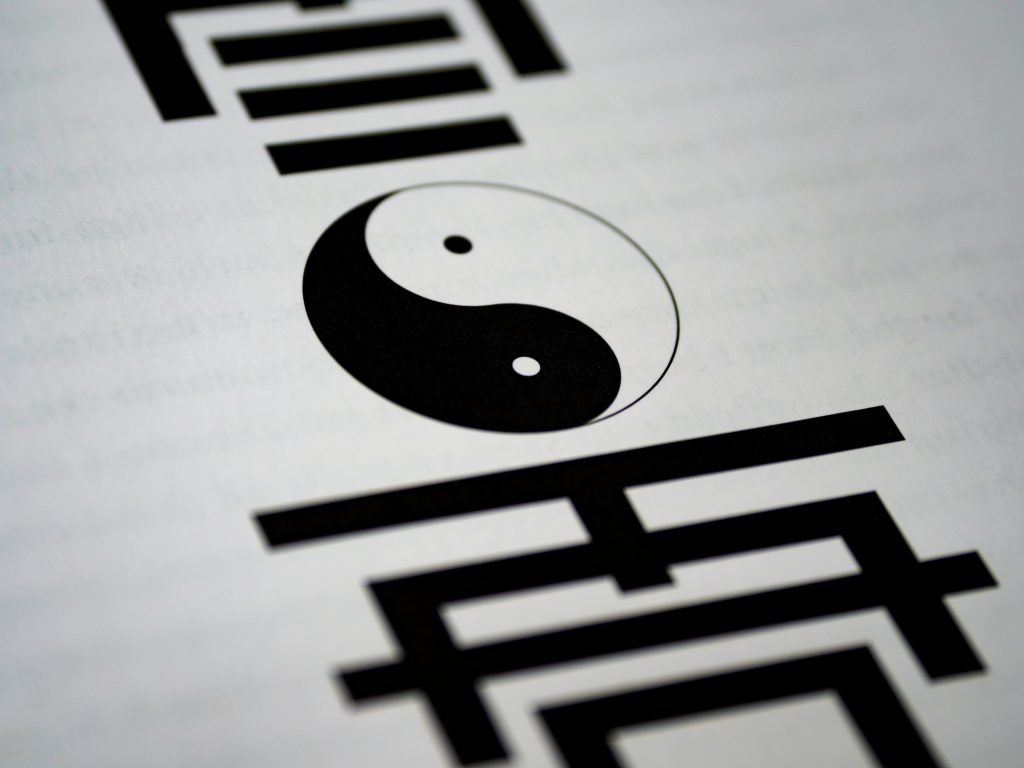
The Bagua is an important concept in Feng Shui that helps to identify the different areas of a space that correspond to different aspects of life. It is typically represented as an octagon or square divided into eight sections, with each section corresponding to one of the eight trigrams. The Bagua is often overlaid onto a floor plan of a building or a room, with the center of the Bagua aligned with the front door or the main entrance.
Each of the eight trigrams of the Bagua represents a different aspect of life, and is associated with a particular direction, element, color, and shape.
When using the Bagua to analyze a space, practitioners of Feng Shui will typically focus on the area of the Bagua that corresponds to the aspect of life they are seeking to enhance. For example, if someone is seeking to improve their career prospects, they may focus on the area of the Bagua that corresponds to the north direction, which is associated with the Kan trigram. They may then make adjustments to the space, such as adding a water feature or rearranging furniture, to promote better energy flow in that area.
In conclusion, the Bagua is a key tool in Feng Shui that helps to identify the different areas of a space that correspond to different aspects of life. Each of the eight trigrams of the Bagua represents a different energy, and is associated with a particular direction, element, color, and shape. Practitioners of Feng Shui use the Bagua to analyze the energy flow in a space and to make adjustments to promote better energy flow and enhance the desired aspects of life.
The trigrams and their associations are as follows:
- Qian (Heaven): associated with the northwest direction, the metal element, the color white, and the shape of a circle. Qian represents the energy of creativity, spirituality, and leadership.
- Dui (Lake): associated with the west direction, the metal element, the color silver, and the shape of an ellipse. Dui represents the energy of joy, social connections, and creativity.
- Li (Fire): associated with the south direction, the fire element, the color red, and the shape of a triangle. Li represents the energy of passion, fame, and recognition.
- Zhen (Thunder): associated with the southeast direction, the wood element, the color green, and the shape of a rectangle. Zhen represents the energy of growth, abundance, and creativity.
- Xun (Wind): associated with the east direction, the wood element, the color blue/green, and the shape of a rectangle. Xun represents the energy of new beginnings, creativity, and growth.
- Kan (Water): associated with the north direction, the water element, the color black, and the shape of a wavy line. Kan represents the energy of career, opportunities, and wisdom.
- Gen (Mountain): associated with the northeast direction, the earth element, the color brown/yellow, and the shape of a square. Gen represents the energy of stability, grounding, and self-cultivation.
- Kun (Earth): associated with the southwest direction, the earth element, the color yellow, and the shape of a square. Kun represents the energy of nourishment, relationships, and stability.